Sign-up to our newsletter and we'll also send you our free ebook on Navigating Social Situations.
Imagine confidently joining any dinner party, indulging in holiday feasts guilt-free, and making lasting memories, all while edging closer to your goals. Sign up now!
You will receive an email from us soon.
Hmm.. something went wrong. If the issue persists, please contact us.
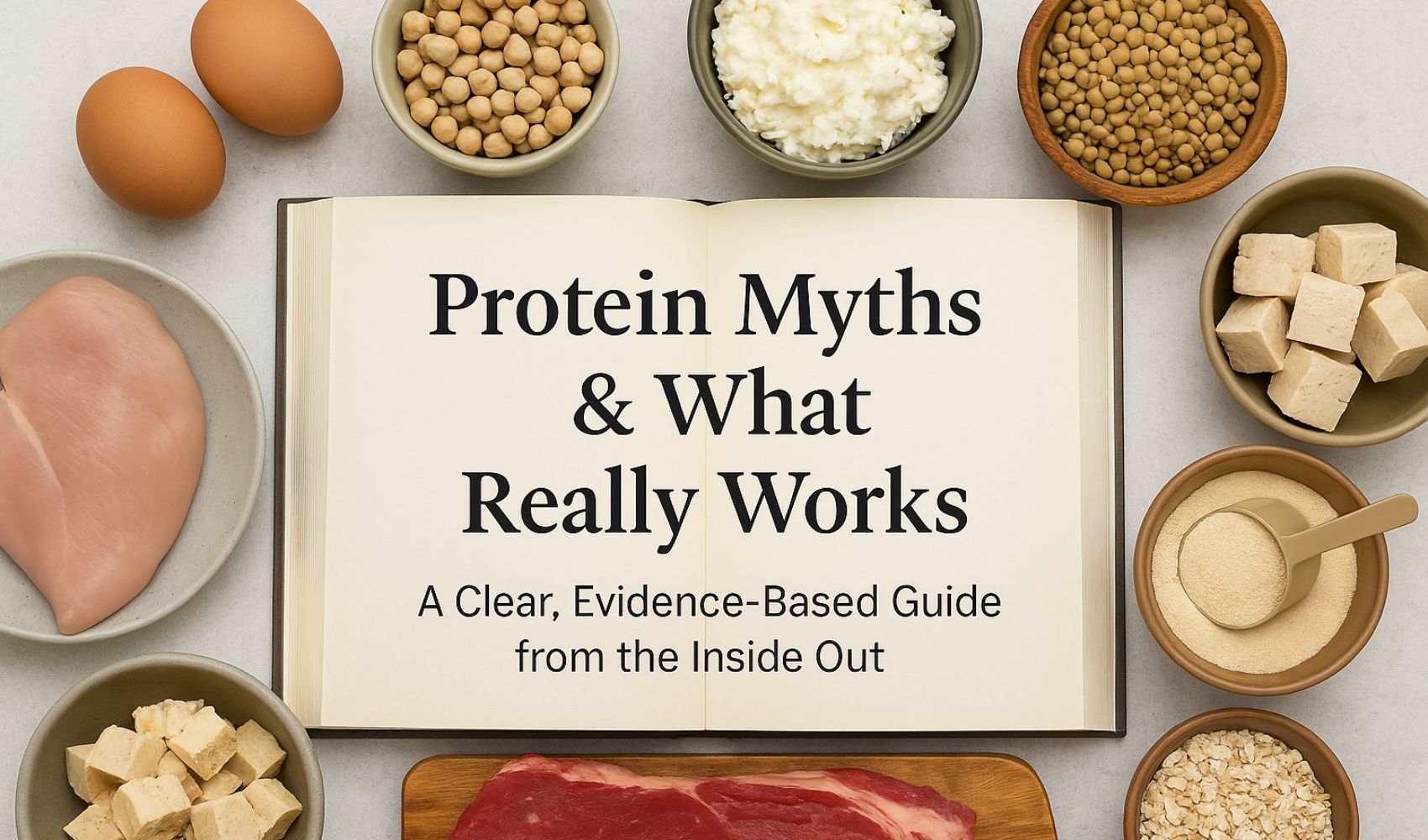
Protein is having a moment. and that’s good. But with the spotlight comes noise: over-hyped information, shortcut “hacks,” and myths that confuse people who just want to train, eat well, and feel their best. This article breaks down three major protein myths using research-backed evidence and key insights from Dr. Layne Norton, Ph.D.
Myth #1: “All protein is created equal.”
Protein is made of amino acids. Some your body can make, and nine essential ones must come from food.
Complete vs. incomplete proteins
Complete proteins contain all nine essential amino acids. Examples: chicken, turkey, fish, eggs, dairy, soy, quinoa, hemp.
Incomplete proteins are missing— or lower in—one or more essential amino acids. Examples: beans, lentils, nuts, seeds, grains.
Incomplete proteins are still valuable. You just need variety or intelligent pairings (like beans + rice) to create a complete amino acid profile throughout the day.
Protein quality matters
Dr. Layne Norton emphasizes two factors:
Leucine content — triggers muscle protein synthesis
Digestibility — how much your body can absorb and use
Animal proteins and soy are rich in leucine and highly digestible, but plant-based eaters can absolutely support muscle growth with sufficient total intake and variety.
Bottom line: Not all grams are equal. Quality, amino acid profile, and digestibility matter, especially for physique and performance goals.
Myth #2: “You must drink a protein shake within 30 minutes of training.”
This is one of the most popular myths, and one of the least supported by research.
What the research shows
Dr. Layne Norton has explained repeatedly that:
Total daily protein intake matters far more than perfect timing.
The “anabolic window” is actually 24–48 hours, not 30 minutes.
Studies comparing immediate post-workout protein vs several hours later show no meaningful difference in muscle growth when daily protein intake is matched.
Practical guidelines
Aim for 3–4 protein-rich meals per day.
If it's convenient to eat before or after training, great, but it’s not essential.
A missed shake doesn’t ruin your workout. Full stop.
Bottom line: Timing is optional. Consistency and total daily intake are what build muscle.
Myth #3: “Too much protein will damage your kidneys.”
Healthy individuals vs. existing kidney disease
Research shows that high-protein diets do not damage healthy kidneys. Increased filtration (hyperfiltration) is a normal adaptation, similar to increased heart rate during exercise.
Where does concern apply? ➡️ People with pre-existing kidney disease should moderate protein intake under medical supervision.
Is there such a thing as “too much” protein?
Yes, but probably not for the reasons you’ve heard.
“Too much” usually looks like:
Eating so much protein that it crowds out fruits, vegetables, fiber, and healthy fats
Relying mostly on processed meats instead of minimally processed sources
For healthy, active individuals: 0.7–1.0g of protein per pound of bodyweight (1.6–2.2 g/kg) is supported as safe and beneficial.
Bottom line: Protein does not damage healthy kidneys within evidence-based ranges. Context and overall diet matter more.
How Much Protein Do You Actually Need?
A simple, effective guideline for most active adults: 0.7–1.0g of protein per pound of bodyweight (1.6–2.2 g/kg)
Spread this across 3–4 meals per day, focusing on lean and minimally processed sources.
Apps like Carbon Diet Coach can calculate a personalized protein target and automatically adjust it based on your goals and progress.
Practical Steps to Apply Today
Anchor each meal with a protein source. (Greek yogurt, eggs, chicken, tofu, fish, lean beef, cottage cheese, edamame, etc.)
Combine plant proteins for a complete profile. (Beans + rice, lentils + quinoa, tofu + edamame.)
Stop obsessing about timing. Eat protein regularly throughout the day, and around your workout if it’s convenient.
Track your total protein. Your daily target is what matters most.
Check overall diet quality. Balance protein with fiber, fruits, vegetables, and healthy fats.
Final Thoughts
Protein is one of your most powerful allies for improving strength, losing fat, recovering faster, and keeping hunger under control. But myths make it harder than it needs to be.
Remember:
Quality matters.
Consistency matters.
Total daily intake matters far more than timing.
And for healthy people, higher-protein diets are safe.
Focus on the fundamentals, and let the myths fall away.
References
Norton LE, Wilson GJ. Leucine and protein quality. University of Illinois, 2010.
BioLayne. “Animal Protein vs Plant-Based Protein: Comparative Impact on Muscle Growth.”
BioLayne. “Protein Timing Not That Important If You’ve Got Enough.”
Jäger R. ISSN Position Stand: Protein & Exercise. 2017.
Health.com. “What Is a Complete Protein?”
EatingWell. “Does Protein Timing Matter for Muscle Growth?” 2025.
Men’s Health. “How Much Protein Do You Need Each Day?” 2025.


.png)
.png)




.jpg)


