Sign-up to our newsletter and we'll also send you our free ebook on Navigating Social Situations.
Imagine confidently joining any dinner party, indulging in holiday feasts guilt-free, and making lasting memories, all while edging closer to your goals. Sign up now!
You will receive an email from us soon.
Hmm.. something went wrong. If the issue persists, please contact us.
Quick answer: ChatGPT and Claude can be helpful for general nutrition questions. What they don't do is run your plan. Carbon sets your calories and macros, then updates them after every weekly check-in using your weight trend, what you logged, and guardrails built from decades of coaching real people.
Key takeaways
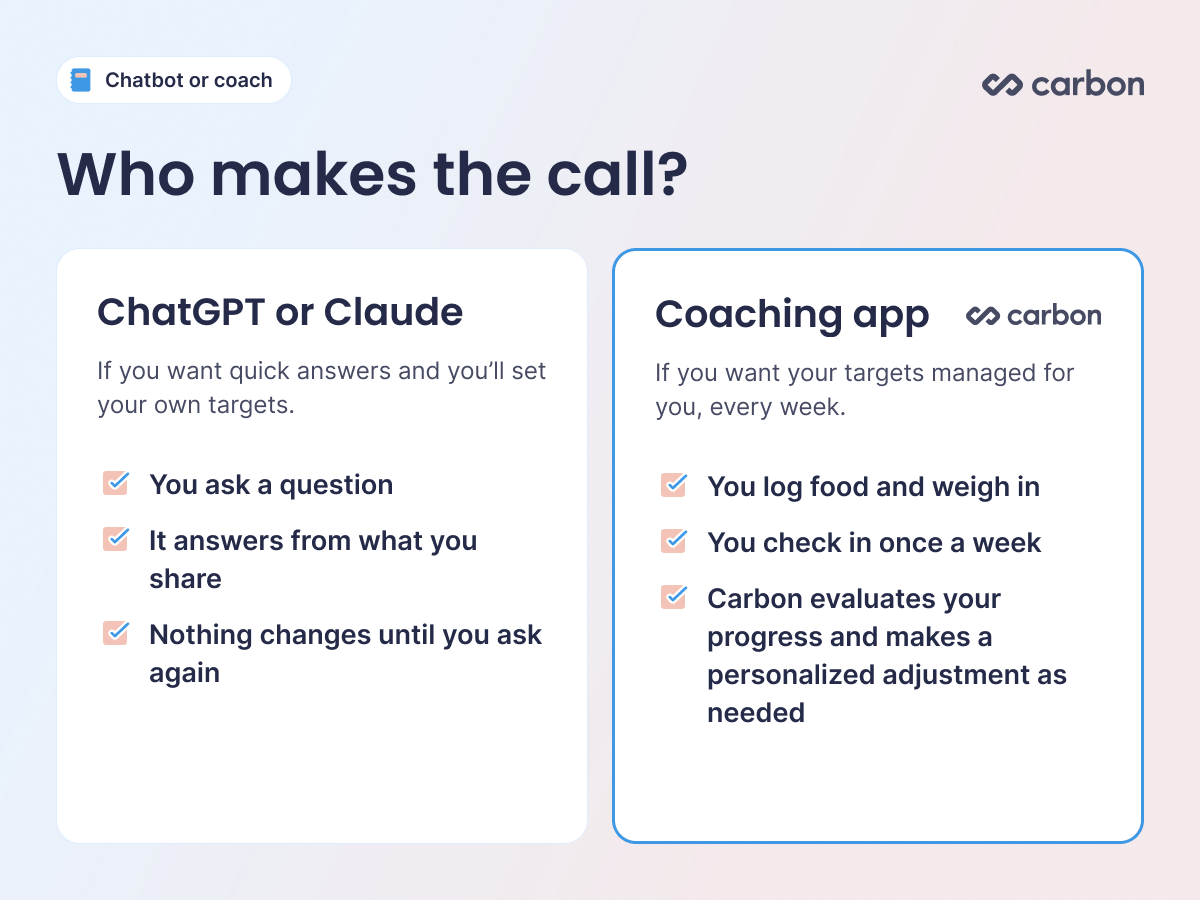
ChatGPT and Claude answer when you ask. Carbon checks in with you every week and updates your targets after each check-in.
Carbon reads your multi-week weight trend and your logged intake the same way every week. A chatbot's answer depends on what you share and how you ask.
Carbon has written guardrails: a limit on how fast you lose and a minimum calorie floor for every user.
Carbon includes a full food tracker with a verified database. ChatGPT and Claude have no food log of their own.
Use a chatbot for questions and ideas. Use Carbon if you want your targets managed for you.
What ChatGPT and Claude do well
Both are fast and flexible, and can be helpful for explaining things. Ask why protein matters, what a reverse diet is, or for a high-protein dinner from what's in your fridge, and you'll likely get a useful answer in seconds.
Both also added health features in January 2026. ChatGPT Health connects to Apple Health, MyFitnessPal and other wellness apps. Claude added Apple Health and Android Health Connect in beta for Pro and Max subscribers in the US.
Where a chatbot falls short as a macro coach
Coaching is a series of decisions: whether to change your calories, by how much, and when to leave them alone. That's where a chatbot runs out.
It waits for you to ask. There's no check-in and no schedule. If you don't bring up a stall, nothing changes.
Its method can shift. Ask the same question twice and you can get two different answers. When a Washington Post reporter gave ChatGPT ten years of Apple Watch data in January, the results were inconsistent enough that OpenAI said it was working to improve consistency.
No built-in guardrails. There's no limit on how fast you lose and no calorie floor unless you ask for one.
Both companies draw the line themselves. OpenAI and Anthropic say their health features don't replace professional medical advice.
Carbon vs ChatGPT vs Claude
Carbon
ChatGPT
Claude
Sets your calorie and macro targets
✓ From your stats, goal and diet preference
Suggests targets if you ask
Suggests targets if you ask
Updates your targets on a schedule
✓ After every weekly check-in
Only when you ask
Only when you ask
Reads your multi-week weight trend
✓ Built in, using weigh-in averages
If you connect Apple Health or paste your data
If you connect Apple Health or Health Connect (beta) or paste your data
Uses what you ate
✓ Compares your logged intake with your targets
If you connect MyFitnessPal or paste your log
If you paste your log
Limits how fast you lose
✓ Raises calories if you lose too fast
Only if you ask
Only if you ask
Minimum calorie floor
✓ Set for every user
None built in
None built in
Same method every week
✓ Same rules at every check-in
Answers can vary
Answers can vary
Explains each change
✓ In your check-in report
When asked
When asked
Food logging
✓ Verified database, barcode and label scanners, Smart Logger
No built-in food log
No built-in food log
Plans around weekends and events
✓ Calorie Planner
Can suggest a plan
Can suggest a plan
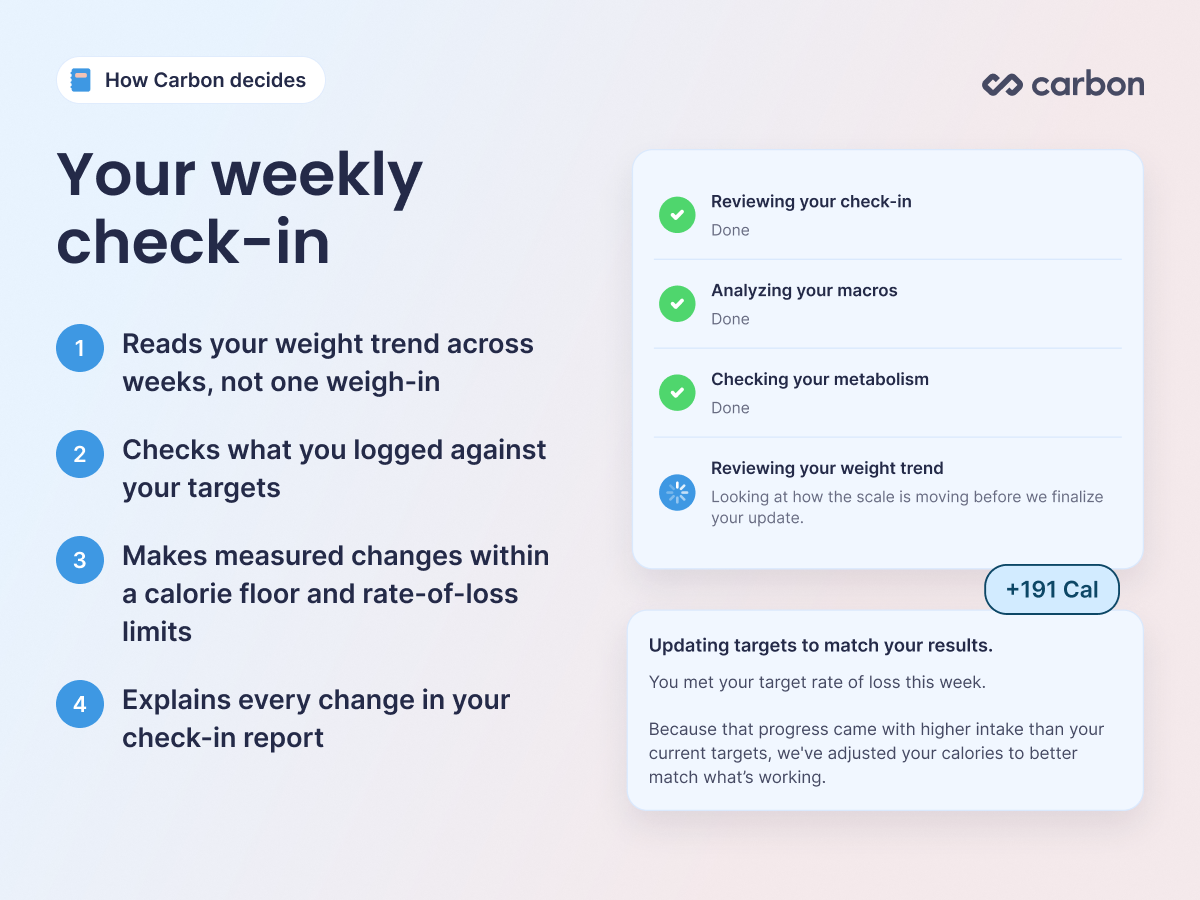
How Carbon's weekly check-in decides
It reads the trend. Carbon averages your weigh-ins across several weeks, so one heavy morning doesn't trigger a change.
It checks what you logged. Carbon compares your intake with your targets. If you didn't track enough of the week, your targets stay the same for another week.
It makes measured changes. When you've truly stalled, Carbon makes a small adjustment. No wild calorie cuts.
It factors in what you ate. Since 2025, adjustments account for the calories you tracked. That update came from endurance athletes whose training outpaced their intake, and from members who ate more than planned but still made progress.
It has guardrails. Carbon limits your weekly rate of loss and sets a minimum calorie floor. If you reach the floor, it recommends a reverse diet or maintenance goal.
It tells you why. Every change comes with an explanation in your check-in report.
Built from decades of coaching
Carbon's coaching system was built by the Carbon team, starting from how experienced coaches adjust a client's plan week to week.
Layne Norton, PhD co-founded Carbon. He holds a BS in biochemistry and a PhD in nutritional sciences from the University of Illinois, where he trained under protein researcher Dr. Donald Layman. He started coaching online in 2005 and, according to BioLayne, has coached more than 70 athletes to pro status. As a competitor, he earned his natural bodybuilding pro card in 2006, won USAPL Nationals in 2014 and 2015, and took silver at the 2015 IPF Worlds with a then world record squat.
Keith Kraker, RD helped build Carbon's coaching algorithm. He's a registered dietitian with a degree in nutrition and dietetics from Eastern Michigan University, has held certifications as a sports nutritionist (CISSN) and personal trainer (NSCA-CPT), and is a former natural bodybuilder and powerlifter.
Carbon's experienced team continually evaluates and reviews the app to make sure users keep making progress toward their goals.
Which should you use?
Use ChatGPT or Claude if you want quick answers about nutrition, meal ideas or help understanding a health number, and you're comfortable setting and changing your own targets.
Use Carbon if you want your calories and macros set for you and updated every week, you've stalled before without knowing what to change, or you want guardrails that keep a diet from going too far.
Plenty of people use both: a chatbot for questions, Carbon for the plan.
Carbon costs $11.99 a month, $59.99 for 6 months, or $99.99 a year. Every plan includes weekly check-ins and support from real people. Start your 7-day free trial.
FAQ
Can ChatGPT or Claude set my macros?
They can suggest starting targets if you give them your stats. They won't check back in or change your targets unless you ask.
Is Carbon an AI app?
Carbon's adjustments come from a coaching system the Carbon team built from years of coaching real clients, and it runs the same rules at every check-in.
Can I use ChatGPT or Claude alongside Carbon?
Yes. A chatbot is handy for recipe ideas and questions, while Carbon handles your targets.
Is it safe to use an AI chatbot for fat loss?
For general information, it can help. Both OpenAI and Anthropic say their health tools don't replace professional medical advice. Without built-in limits, keeping your rate of loss and calorie intake in a safe range is up to you. If you have a medical condition, talk with your doctor.
Does Carbon replace a human coach?
Carbon makes the weekly adjustments a coach would make, and support questions are answered by real people on the Carbon team. It doesn't include one-on-one human coaching.
This article is for informational purposes and isn't medical advice. ChatGPT and Claude details come from OpenAI's and Anthropic's January 2026 announcements and launch coverage, including MacRumors and The Hacker News.
Share
John Ybarra, NBC-HWC, CSCS
John is a National Board Certified Health & Wellness Coach and Certified Strength and Conditioning Specialist who has coached people through fitness, nutrition, and behavior change for nearly two decades, including as a health coach at Vida Health and leading wellness programs at the YMCA. He is VP of Operations at Carbon Diet Coach.